

Khan Gambles & Lost
by Bo Marchionte
@bomarchionte | College2Pro.com
Published May 16, 2026, 9:55 AM
Top-10 Steelers Salaries in 2026
- J. Watt, age 32, salary $42,000,000
- K. Metcalf, age 29, salary $31,000,000
- Alex Highsmith, age 29, salary $20,102,000
- Jalen Ramsey, age 32, salary $17,229,000
- Patrick Quinn, age 27, salary $17,193,334
- Aaron Rodgers, age 43, salary $15,015,000 (Club Option)
- Cam Heyward, age 37, salary $13,675,000
- Pat Freiermuth, age 28, salary $11,200,000
- Michael Pittman, age 29, salary $8,666,666
- Jaylen Warren, age 28, salary $7,033,383
The Steelers are hardly alone in paying premium money to veteran players or to talent that began their careers elsewhere. Around the NFL, some of the biggest cap numbers belong to older players who changed teams along the way.
What stands out in Pittsburgh is how general manager Omar Khan has built this roster. Rather than importing younger stars through free agency or blockbuster trades, Khan has largely hunted for value and, when convinced a player can help immediately, rewarded him with top-of-the-market money. Perhaps the Steelers pursued younger options and those deals never materialized. Unless someone inside the building says so, we may never know.
On Friday, May 15, I wrote on SportsGrid about Chris Boswell’s contract extension. There is no rational argument against Boswell getting paid. One of the most accurate kickers in NFL history, he now joins Cowboys Brandon Aubrey as the highest-paid kicker in football.
But there is one notable distinction.
Aubrey is 31 years old. Boswell is 35.
That age difference sent me down a rabbit hole, digging through salaries and cap figures to better understand Khan’s roster-building philosophy and how aggressively the Steelers are investing in veteran players.
- J. Watt and the Price of Loyalty
Entering 10th year in the league: T.J. Watt Key Numbers at age 32
- Five of his nine seasons he hasn’t played entire schedule
- 2025 was lowest sack total (7) since rookie season in 2017
- 2025 his tackles for loss tied for second with 10, matching his rookie total
- Nick Herbig will gain snaps at the expense of both Watt and Alex Highsmith
- James Harrison last double-digit sack total (10.5) came when he was 32, he played until he was 39
- 27 years old, Micah Parsons (2025): 4 years, $188 million (47M APY)
- 32 years old, T.J. Watt (2025): 3 years, $123 million ($41M APY)
There are franchise cornerstones, and then there are players who become part of the foundation. T.J. Watt is the latter.
When Pittsburgh Steelers and Omar Khan agreed to a three-year, $123 million extension with Watt, they were doing more than rewarding one of the most decorated defenders in franchise history. They were doubling down on a player who turns 32 this season and carries one of the heaviest financial commitments in football.
Watt’s deal included a $40 million signing bonus and at signing. His average annual salary of $41 million once made him the highest-paid non-quarterback in NFL history. In 2026 alone, his cap hit balloons to $42 million, by far the largest on Pittsburgh’s roster.
Paying for What He Has Been
Watt is already an NFL Defensive Player of the Year Award winner, multiple-time All-Pro, and future Hall of Fame candidate. He has defined the Steelers defense for nearly a decade.
When healthy, he still changes games with one snap.
Offensive coordinators slide protections his way. Tight ends chip him. Running backs are assigned to help. Yet he continues to wreck game plans with his rare timing, hand violence and ability to flatten to the quarterback.
Those traits are why players like Watt get paid.
Paying for What He Can Still Be
This is where Omar Khan walks the tightrope.
General managers must reward iconic players while also protecting the future. Khan understands the emotional and symbolic value of keeping homegrown stars in Pittsburgh. He also understands that every massive contract limits financial flexibility elsewhere.
Watt’s $42 million cap hit represents both a commitment and a gamble.
The commitment says the Steelers believe he can still perform like one of the NFL’s premier defenders.
The gamble is that age does not arrive before the contract runs its course.
The Rooney Factor
Team president Art Rooney II has long favored continuity and loyalty. The Steelers are one of the few franchises that consistently allow legendary players to finish their careers in Pittsburgh.
“Yeah, I’m not sure why you waste a year of your life not trying to contend,” Rooney the second told local media after Mike Tomlin left Pittsburgh. “Obviously, your roster is what it is every year. It changes every year, so you deal with what you have every year and try to put yourself in a position to compete every year. Sometimes you have the horses, sometimes you don’t. But I think you try every year.”
He clear he is against the rebuild mindset and may fall into play how Khan navigates the maneuvers to acquire proven veteran talent but at the cost of age.
That philosophy creates stability, but it can also delay the difficult transition from proven veterans to younger, less expensive talent.
In Watt’s case, Rooney and Khan chose trust over caution.
D.K. Metcalf and the Cost of Going All-In
Metcalf’s First Year in Pittsburgh
- Targets – Lowest in career 99
- Receptions – Second lowest in career (59), lowest is rookie season (58)
- Receiving Yards – Lowest in career (850)
- Yards Per Catch – Lowest in career (10.5)
- Touchdowns – Second lowest in career (6) for second with 5 being lowest in career
If T.J. Watt’s extension was about loyalty, the acquisition of D.K. Metcalf was about urgency.
Omar Khan did not trade for Metcalf to think small. He made one of the boldest moves of his tenure, then immediately backed it up with a four-year, $132 million extension that carries an average annual salary of $33 million.
At the time of the deal, Metcalf became the highest-paid player in Pittsburgh Steelers history based on total contract value and one of the highest-paid wide receivers in the NFL.
That is not the ‘Rooney Way’. That was the exact opposite of tearing it down. It was absolutely about resurrecting the franchise.
The message was unmistakable.
In reality they did not acquire a true elite No. 1 target like a Ja’Marr Chase of Justin Jefferson. Metcalf is not that guy, but he’s darn good, but not that good.
Paying for Prime Years
He turns 29 during the 2026 season and remains one of the league’s most imposing receivers at 6-foot-4 and 235 pounds. His game is built on rare size, long-strider acceleration and the ability to overwhelm defensive backs at the catch point.
Metcalf’s frame, catch radius and vertical speed force safeties to widen, opening space for the rest of the offense. He is not simply a target. He is a structural stress point for every defense he faces.
Pittsburgh did not draft Metcalf. They identified a proven elite talent, paid the acquisition cost, and then committed to him as a foundational offensive piece.
This is the kind of move teams make when they believe they are close.
Maybe it pans out better in 2026.
Alex Highsmith and the Value of Homegrown Talent
Not every major contract in Pittsburgh is accompanied by headlines and national attention.
Some are built quietly, through steady development and consistent production.
That is exactly how Alex Highsmith earned his four-year, $68 million extension.
Selected in the third round of the 2020 NFL Draft out of Charlotte, Highsmith arrived as an under-the-radar prospect with intriguing traits but little fanfare. He was not expected to become one of the NFL’s more complete edge defenders.
Development the Steelers Way
Highsmith represents the model Pittsburgh has followed for decades.
Draft and develop.
His game is built on technical efficiency rather than rare athletic traits. He wins with disciplined hand usage, leverage, relentless effort and a polished understanding of how to attack protections.
That all-around reliability made him indispensable opposite T.J. Watt.
Prime Production at a Reasonable Price
This was one where Khan wins the signing. The rare occasion when the player presumably had his best years ahead of him, especially at 26.
His $17 million average annual salary now looks like one of the more team-friendly deals on the roster, especially as elite edge rusher contracts continue to escalate.
When compared to Watt’s $41 million annual average, Highsmith provides premium production at a fraction of the cost.
Jalen Ramsey and the Gamble on Reputation
PFF Grades on Ramsey in 2025 (Higher percentile is better)
- 16th Percentile: Coverage Grade on Quick Throws
- 22nd Percentile: Coverage at Free Safety
- 32nd Percentile: Coverage in the Slot
- 98th Percentile: Coverage in the Box
- 93rd Percentile: Missed Tackles (Technically not missing tackles)
Every aggressive front office eventually makes a move that tests the boundary between proven pedigree and declining performance.
For Omar Khan, that move may be Jalen Ramsey and doesn’t seem to have paid off.
The former All-Pro corner arrived in Pittsburgh with a résumé that once made him the most feared defensive back in football. He also arrived with a substantial contract. Ramsey carries a 2026 cap hit of more than $17.2 million and an average annual salary of over $21 million.
On paper, the Steelers are paying for a shutdown corner. They got an enforcer who excels at nickel and safety with a hefty price tag attached to his contract.
At his peak, Ramsey was a rare talent.
He combined elite length, fluid movement skills and the physical temperament to erase top receivers. He could press at the line of scrimmage, play through the catch point and bring a level of swagger that often dictated the emotional tone of a defense.
Few cornerbacks in his era matched his complete skill set.
That version of Ramsey was worth every dollar.
The Reality of Age
Ramsey turns 32 during the 2026 season.
Another name from last season was Darius ‘Big Play’ Slay didn’t last the season in Pittsburgh, being cut on December 2nd. He was like Darius ‘Bad Play’ Slay at the age of 34.
For cornerbacks, that is a dangerous age.
The position depends heavily on recovery speed, transition quickness and the ability to mirror explosive athletes in space. Even a slight loss of burst can be exposed quickly.
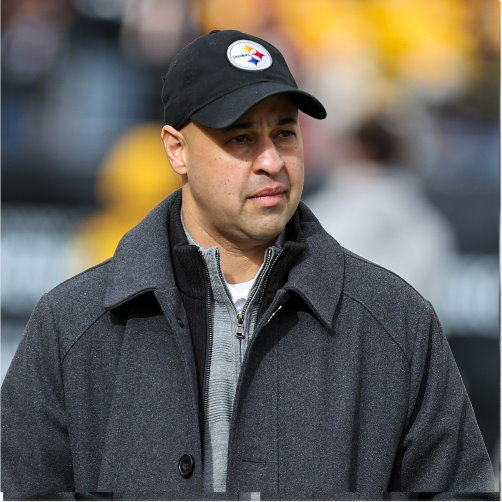
Photo Credit Frank Hyatt/College2Pro.com
