

Big Man with a Bigger Heart
by Bo Marchionte
@bomarchionte | College2Pro.com
Published March 16, 2026, 9:09 AM
Covering a professional football team is one of the odd little arrangements in American life.
You are there to work, to dig, to listen, to catch the truth as it slips out between clichés and men trying not to be bothered. But first, before any of that, most of us got into this racket because we loved the game.
That’s the dirty little secret of the profession.
We are supposed to keep a professional distance, and mostly we do, but nobody ends up in a locker room in the spring, throughout summer and into the dead of winter, without first being a fan of football and the people brave enough to play it.
So, there we are, the media, a wandering collection of notebooks, phones, cameras and half-finished questions, moving through an open locker room like door-to-door salesmen nobody invited in.
Some come from giant television networks with makeup rooms and producers. Others come from little outlets still hanging on in the digital age with grit, prayer and a decent Wi-Fi signal. Big shots and nobodies (like me), all packed into the same room, all chasing the same thing.
And the players know it.
Some of them treat the media scrum like an old obligation. Some treat it like a tax audit. Some avoid eye contact with the kind of precision usually reserved for a bad date who already knows there won’t be a second one.
You approach, hopeful and smiling, and they drift away toward a training table, a towel, a trainer, a locker, a conversation suddenly so urgent it must happen right now. That is the harmony and dysfunction of the professional locker room. Everybody needs each other. Nobody fully trusts each other. Everybody is working. Everybody is in somebody else’s way.
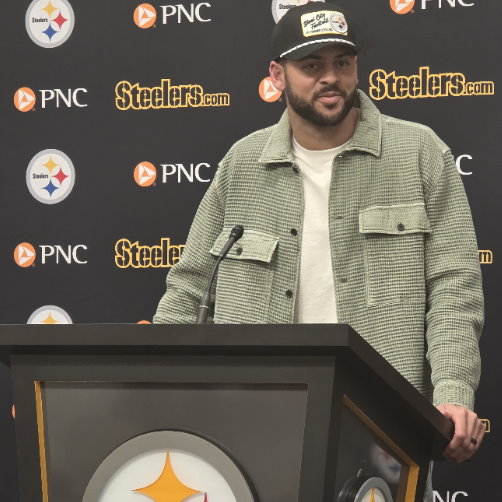
That is what made Michael Pittman Jr. feel different the moment he walked into the room to be introduced with the Pittsburgh Steelers.
He came into the media room on the South Side wearing a light green button-down over a T-shirt. At 6-foot-4 and 223 pounds, Pittman does not exactly sneak into a room. But it wasn’t merely size that turned heads. It was the warmth. It was the ease. It was the uncommon feeling that here was a player who was not bracing for the questions, not preparing to deflect them, not looking past you toward the exit.
He looked at you the way an actual human being does.
Not combative. Not rehearsed. Engaged. His answers did not die at the podium. They carried shape and detail and intent. He spoke as if words mattered, as if the people asking the questions had a job worth respecting.
“Absolutely, I mean, like, I just want to give people, like, the time of day, you know,” Pittman said. “Because everybody’s job is hard just trying to help, like, you guys out and give you guys the time of day and help out the fans to get the inside stuff.”
That is not nothing.
In this business, sincerity stands out because so much of the rest can feel transactional. A locker room is full of gifted men, but not always generous ones. Pittman came off as both. You could feel the conjunction in him right there at the podium. Warmth, athleticism, and a genuine concern for other people. Not the staged kind.
And yet there is steel in him, too.
It takes a certain boldness to stand in front of cameras and microphones and let your words come out on their own terms, especially when you know some people are listening for the stutter instead of the substance. Pittman addressed it himself, calmly and without self-pity.
“Sorry. Like, I’m up here, like, stuttering,” he said. “So, for those of you that don’t know, like, I stutter a lot. So, it’s not because I’m nervous. It’s just a thing that I’ve done, like, since I was a kid. I’ve actually worked with the NSA on it, the National Stuttering Association.”
There was courage in that moment, but more than courage, there was care. He did not rush past it. He did not hide from it. He explained it with the same attention to detail he gave everything else. Pittman could have used that as an excuse, instead he mentioned the NSA (National Stuttering Association) and explained the fears he’s managed to concur.
The Steelers did not just acquire a receiver. They may have brought in the kind of presence a locker room needs more of.
Since arriving in the NFL in 2020, Pittman has lived the unstable life of a receiver trying to build rhythm while the ground keeps shifting beneath him. Every season, it has been a different quarterback. Philip Rivers. Carson Wentz. Matt Ryan. Gardner Minshew. Anthony Richardson. Daniel Jones. Now, in Pittsburgh, the next chapter figures to continue that strange trend, whether the ball comes from Aaron Rodgers, Mason Rudolph, or Will Howard.
For most receivers, that kind of yearly upheaval is a tax on production. Timing changes. Trust changes. The shape of the offense changes. A receiver can spend half a career adjusting to circumstances he never asked for.
Pittman seemed to hint at that reality without bitterness when he spoke about Indianapolis. He did not bury the Colts. He did not take a shot at Shane Steichen. He simply spoke with the kind of frankness that rarely survives inside NFL walls.
“Yeah, so I don’t want to give up his secret sauce,” Pittman said of Mike McCarthy, “but it was very positive and diversifying the things that I can do. Because obviously, like in Indy, like I played a certain role there. So just getting back to where I have more of a diverse route tree and stuff like that.”
Read the tea leaves.
Pittman was not complaining. He was telling the truth. In Indianapolis, especially since 2023, his role felt more restricted, more boxed in, more assigned than explored. In Steichen’s first season, Pittman piled up a career-high 156 targets. But in 2024 and 2025, he drew 111 targets each season, his lowest totals since catching only 61 as a rookie in 2020. The usage was there, but the freedom seemed narrower.
“I mean, back in my role there, I mean, like, we all had very specific roles,” Pittman said. “Whether it was me, Tyler Warren, Josh Downs, like Alec Pierce. We all kind of played to our roles, and mine was mine, because that’s what was decided.”
Again, not anger. Not resentment. Just transparency.
And transparency is rare enough in these buildings to make you stop writing for a second and just listen.
That is why Pittsburgh makes sense.
McCarthy’s offense, at least in theory, should widen the field for Pittman in every way. More route diversity. More chances inside and outside. More opportunity to be moved around instead of pinned down. More room for a receiver with size, body control and functional toughness to become something more than a role player with a name.
This is where career highs begin to feel possible.
A healthy, featured Pittman in McCarthy’s offense should have a real chance to set new marks in receiving production. Not because he suddenly becomes a different player, but because he gets a chance to be a fuller version of the one, he already is.
