

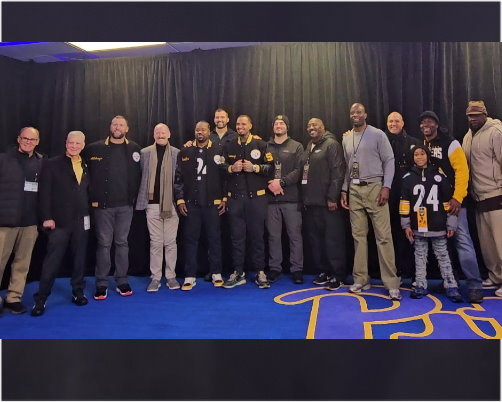
Steelers Pregame
by Bo Marchionte
@bomarchionte | College2Pro.com
Published December 21, 2025, 2:09 PM
Pittsburgh, PA – On Monday night, before the lights came up and the game began, the Steelers did what franchises do when they wish to remind themselves who they are. Ben Roethlisberger. Joey Porter Sr. Maurkice Pouncey.
The Hall of Honor is not nostalgia, it is institutional memory, a franchise reminding itself of what excellence looks like.
Levon Kirkland was in attendance.
Kirkland has always existed slightly outside the frame too large, too fluid, too anomalous to fit neatly into the categories the NFL prefers. In 1992, coming out of Clemson, he was listed at 6-foot-1, 275 pounds. A linebacker built like a defensive tackle, moving like someone who had no business carrying that much mass. The league did not quite know what to do with him. Pittsburgh, characteristically, decided to find out.
His shoulder pads, famously oversized even by early-1990s standards, made him impossible to miss.
Satellite dishes beneath black and gold. But focusing on the spectacle missed the point. Kirkland was not large for effect; he was large as function. He finished his career with 1,026 tackles, 19.5 sacks, and 11 interceptions. A consensus All-American in 1991. A member of the NFL’s 1990s All-Decade Team. First-Team All-Pro in 1997. Two Pro Bowls. Numbers that suggest not novelty, but sustained dominance.
The roots of that dominance were not linear.
Kirkland did not grow up inside football’s youth-industrial complex. “I never played Pop Warner. I never played Pee Wee. My father wouldn’t let me play until I was in the ninth grade,” he said. He was the youngest brother, which meant perpetual disadvantage—slower, weaker, always chasing. He compensated not by specialization, but by accumulation. Basketball. Track. Tennis. A résumé that reads less like a linebacker’s origin story and more like an argument against early narrowing.
Basketball, he admits, was the first love. He played power forward at a small school, good enough to dream, not tall enough to continue dreaming. Tennis, improbably, mattered more. “Tennis is amazing for lateral movement; you’re running back and forth side to side the whole time.”
Track sharpened endurance. None of it was strategic at the time. “You’re just playing a sport.” Only later did it reveal itself as preparation. Coverage ability. Sideline-to-sideline range. Even at 280 pounds, Kirkland believed size was not a limitation but leverage. “I thought it was my advantage… I knew I could move just as good, or even better than most guys.”
That belief was private for a long time. He kept his professional ambitions secret.
“I was 11 years old, and I told myself I was gonna play pro ball. Never told anybody,” said Kirkland.
When a high school coach told him he could play at the next level, Kirkland assumed it meant small college football. Clemson came instead. So did validation. A graduate assistant told him, plainly, that if he kept working, he could be one of the best linebackers ever. Kirkland accepted it not with disbelief, but alignment. Someone else had finally articulated what he already knew.
Pittsburgh arrived through a mix of coincidence and something closer to faith. A childhood Steelers pajama set, inexplicably gifted by a father who didn’t follow football. A bathroom mirror before the draft. More ironic Kirkland reveals in those days he routed for the Dallas Cowboys and still get Pittsburgh gear for Christmas.
“They’re gonna pick me,” said Kirkland. They did.
Bill Cowher was young then, intense, uninterested in comfort. Kirkland remembers the lesson vividly. Cowher told him he had to take over the huddle filled with Kevin Greene, Greg Lloyd, Rod Woodson. Then walked away. No instructions. No reassurance.
So, Kirkland borrowed a personality.
Mike Singletary.
“Just act like him (Singletary), until you become that person.”
It was not imitation as theater, but as method. Authority learned through repetition. Confidence constructed before it was felt. “It really teaches you,” said Kirkland. “Having a belief in yourself beyond what you even thought was possible.”
Veterans did not yield respect easily. You earned it, or you were dismissed. Kirkland earned it.
Years later, the respect comes back to him unprompted. Players. Teammates.
Watching the Hall of Honor ceremony, it was hard not to notice the symmetry. A franchise celebrating its past while one of its most singular embodiments stood nearby, unofficial, unavoidable. It feels less like an omission than a delay.
Time tends to correct these things.
Eventually, the Steelers will honor Levon Kirkland in their ultimate salute to greatness. Not because sentiment demands it, but because history does.
Photo Credit Frank Hyatt/College2Pro.com
