

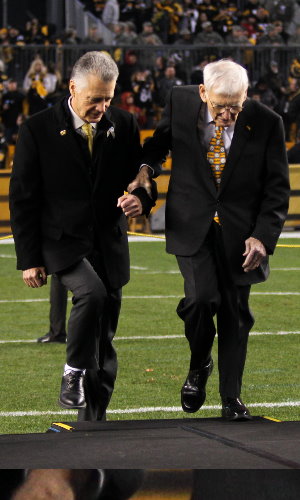
Rooney II Changes Formula from Father & Grandfather
by Bo Marchionte
@bomarchionte | College2Pro.com
Published January 26, 2026, 5:29 PM
Youngstown, OH – The irony of the 2026 Super Bowl matchup is hard to ignore for Pittsburgh. On one sideline stands Mike Vrabel, the blue-collar linebacker the Steelers drafted in the third round in 1997, a player who embodied the franchise’s ethos long before he ever wore a headset. On the other is Mike Macdonald, the young defensive prodigy who represents exactly the type of modern hire many Steelers fans believed would be the next logical step in Pittsburgh’s succession plan.
Vrabel’s journey reads like a case study in how nonlinear NFL coaching success can be. He took over the Tennessee Titans in 2018, built a tough physical identity, reached the playoffs three times in six seasons, and made his last postseason appearance in 2021. Then came two losing seasons, an organizational reset, and a year away from football after his firing. Now, in one season in New England, he has engineered a turnaround that has the Patriots back on the sport’s biggest stage. If Vrabel had been available during Pittsburgh’s coaching search, it’s hard not to imagine how attractive he would have been to a fan base craving grit, accountability, and cultural continuity. He felt like a Steeler long before he was ever drafted by one.
Instead, the Steelers went with Mike McCarthy, a Super Bowl winning coach with a decade and a half of head coaching experience and a reputation as one of the league’s most accomplished offensive minds. McCarthy’s Pittsburgh roots should resonate with a Yinzer fan base that values local ties and institutional knowledge, yet his hiring has landed with mixed emotions.
The prevailing sentiment among many fans was a desire for a clean slate a young, modern hire who could usher in a new era. McCarthy, at 62, represents stability and pedigree, but also familiarity in a league increasingly defined by innovation and youth.
Then there is Macdonald, just in his second season as Seattle’s head coach, already 24–10 and leading the Seahawks to an NFC title. His ascent is the type that fuels the league’s obsession with young coordinators and schematic evolution. Pittsburgh, after all, has long had a formula that bordered on mythological: Chuck Noll at 37, Bill Cowher at 35, Mike Tomlin at 35. Three young, first-time head coaches, three defensive minds, six Lombardi Trophies, and each of them reaching at least two Super Bowls. It wasn’t just continuity.
It was dynasty-building by design.
McCarthy’s hire represents a philosophical departure from that doctrine. He is nearly double the age of his predecessors at the time of their hiring, an offensive architect stepping into a franchise historically defined by defense and youth. Art Rooney II, in choosing McCarthy, signaled a willingness to abandon a formula that had defined the Steelers for more than half a century. Whether that decision is visionary or risky will only be answered in hindsight.
What makes this Super Bowl particularly instructive is how differently New England and Seattle arrived here. The Patriots went with a proven former head coach, betting on experience, leadership, and cultural reset.
Seattle went with a young defensive innovator and embraced the modern trend. Elsewhere, the Raiders attempted to follow New England’s model by hiring Pete Carroll, only to pivot quickly after a short-lived experiment.
The Titans attempted their own reset with Brian Callahan, only to pull the plug before he could even complete his second season, with a rookie quarterback under center and organizational patience already exhausted. The lesson is uncomfortable but undeniable, there is no blueprint that guarantees success.
However, the Las Vegas Raiders hired Super Bowl winning coach Pete Carroll and fired him after one season. Hot young coordinator or established Super Bowl winning head coach both failed miserably in this example.
Coaching hires are a cocktail of organizational alignment, roster talent, timing, quarterback play, and a dose of luck that front offices will never admit. No one knew that a sixth-round quarterback named Tom Brady would help a retread coach like Bill Belichick build the most dominant dynasty in modern sports.
No one knew that Vrabel would need to fail, reset, and land in the perfect environment to reach another Super Bowl. No one knew that Macdonald would accelerate Seattle’s timeline so rapidly.
Pittsburgh now stands at its own inflection point. The left tackle position remains unresolved. The quarterback situation is unsettled. The defense is aging and expensive. The roster has holes that pedigree alone cannot fill. In that context, it’s understandable why the Steelers might prioritize experience and infrastructure in a coach like McCarthy. It’s also understandable why fans might crave the mystery and potential of the next young genius.
The truth, as always in the NFL, is that nobody knows. Not the fans. Not the front office. Not even the coaches themselves. Dynasties are built by design, but also by accident. The Steelers changed their formula, and whether that deviation leads to a renaissance or a reckoning will depend on far more than the name on the headset.
Lightning in a bottle is never guaranteed. Pittsburgh spent half a century believing it had the formula. Now, like the rest of the league, it’s searching again.
Photo Credit Frank Hyatt/College2Pro.com
