

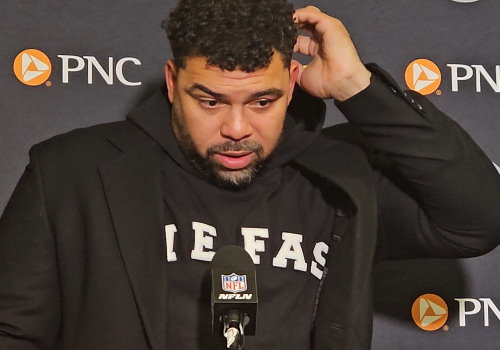
Cam Tops the Charts
by Bo Marchionte
@bomarchionte | College2Pro.com
Published Jine 2, 2026, 7:21 AM
PFF Percentile Snapshot
- 95th Percentile Pass Rush Grade
- 88th Percentile Pass Rush Grade on True Pass Sets
- 90th Percentile Pass Rush Grade Without Play Action
- 96th Percentile Pass Rush Win Rate
- 97th Percentile Run Defense Grade
- 94th Percentile Run Stop Percentage
Cam Heyward: Defying Time, Defining the Standard
At 37 years old, Cam Heyward isn’t supposed to be doing this.
Defensive linemen typically begin battling the realities of age long before reaching their late 30s. The wear and tear of thousands of collisions eventually catches everyone. Yet somehow, Heyward continues to perform at a level that rivals players a decade younger.
The numbers aren’t just impressive for a veteran. They’re elite by any standard.
A Masterclass in Consistency
What makes these metrics remarkable is their balance.
Many interior defenders excel as pass rushers or run defenders. Very few dominate both areas. Heyward remains among the league’s best regardless of situation.
His 96th-percentile pass-rush win rate shows he is still defeating blockers at an elite level. His 95th-percentile overall pass-rush grade confirms that those wins consistently translate into disruption.
Against the run, the story is even more impressive.
A 97th-percentile run-defense grade paired with a 94th-percentile run-stop rate illustrates a player who continues to control the line of scrimmage and finish plays at a rate few defenders can match.
The Standard in Pittsburgh
The Steelers enter 2026 with an intriguing defensive line room. Derrick Harmon represents the future. Keeanu Benton is approaching a contract crossroads. Younger players are trying to establish themselves.
Yet every conversation still begins with No. 97.
For nearly a decade and a half, Heyward has been the measuring stick inside the Steelers’ locker room. Preparation. Leadership. Accountability. Production. The expectation is set by the veteran standing at the front of the room.
The reality is simple: Harmon and Benton aren’t being asked to replace Cam Heyward today. They’re being asked to learn from one of the finest defensive linemen of his generation while they still can.
Because eventually Father Time wins.
For now, though, Heyward appears to be making him work overtime.
PFF Percentile Snapshot
- 21st Percentile Pass Rush Grade
- 21st Percentile Pass Rush Grade on True Pass Sets
- 22nd Percentile Pass Rush Grade Without Play Action
- 25th Percentile Pass Rush Win Rate
- 42nd Percentile Run Defense Grade
- 55th Percentile Run Stop Percentage
Derrick Harmon by the Numbers: The Traits That Jump Off the Page
Raw percentile rankings don’t always tell the whole story, but they do help paint a picture of what a player is and sometimes what he isn’t.
For Steelers second-year defensive lineman Derrick Harmon, these PFF metrics suggest a prospect whose value is rooted more in controlling the line of scrimmage than chasing quarterbacks around the edge.
What It Means
At first glance, the pass-rush numbers won’t wow anyone. Harmon graded in the bottom quarter of qualifying defenders in several key pressure-related categories, including overall pass-rush grade, true pass-rush situations, and pass-rush win rate.
That profile suggests he wasn’t consistently winning one-on-one opportunities as a pure disruptor. In today’s NFL, where sack totals often dominate headlines, those metrics can appear concerning.
However, the run-defense data tells a different story.
Harmon’s 55th-percentile run-stop rate was actually above average, while his 42nd-percentile run-defense grade shows a player capable of holding his ground and contributing against the run. That’s often where larger interior defenders earn their keep early in their careers.
The Steelers have never required every defensive lineman to be a statistical pass-rushing star. Their defensive fronts have historically featured players who absorb blocks, maintain gap integrity, and allow playmakers around them to attack.
The Bigger Picture
These numbers don’t necessarily describe who Harmon will become. They simply describe where he was at this stage of his development.
The encouraging takeaway is that run defense tends to translate more consistently from college to the NFL, while pass-rush production can take time to develop through coaching, technique refinement, and increased strength.
For now, Harmon’s profile looks less like a finished product and more like a young defensive lineman with a sturdy run-defense foundation and plenty of room for growth as a pass rusher. And in Pittsburgh, that development path has worked out pretty well before.
PFF Percentile Snapshot
- 74th Percentile Pass Rush Grade
- 58th Percentile Pass Rush Grade on True Pass Sets
- 45th Percentile Pass Rush Grade Without Play Action
- 73rd Percentile Pass Rush Win Rate
- 37th Percentile Run Defense Grade
- 82nd Percentile Run Stop Percentage
Keeanu Benton: Why 2026 Could Be a Defining Season
If Derrick Harmon represents the future, Benton may be one of the biggest present-day questions facing Pittsburgh’s defensive front.
Entering his third NFL season, Benton is quietly approaching a pivotal crossroads. The former second-round selection is scheduled to become an unrestricted free agent following the 2026 season, placing added significance on what could be a career-defining year.
What Stands Out
Unlike Harmon, whose profile leans toward run support and developmental upside as a pass rusher, Benton’s metrics tell the story of a disruptive interior defender.
His 74th-percentile pass-rush grade and 73rd-percentile pass-rush win rate rank comfortably above average, showing a player capable of consistently creating pressure from the interior. That’s a valuable trait in today’s NFL, where collapsing the pocket from the inside often disrupts quarterbacks more than edge pressure alone.
The most intriguing number may be the 82nd-percentile run-stop rate. When Benton identifies and finishes a play against the run, he does so at a high level. However, his overall 37th-percentile run-defense grade suggests there is still room for greater consistency snap-to-snap.
Why Harmon Matters
As Harmon prepares to enter his second NFL season, Pittsburgh’s long-term planning along the defensive line becomes increasingly interesting.
The Steelers invested a first-round pick in Harmon with the expectation that he can become a cornerstone piece. At the same time, Benton is entering the final stretch before free agency, creating a natural evaluation window for the organization.
If Benton takes another step forward as an interior pass rusher, he could force Pittsburgh into a difficult contract decision. If Harmon develops quickly, the Steelers may feel more comfortable transitioning toward a younger and potentially less expensive defensive-line core.
Either way, the 2026 season isn’t just about production. It’s about determining what the Steelers’ defensive front will look like beyond 2027. And Benton may be one of the biggest pieces of that puzzle.
PFF Percentile Snapshot
- 12th Percentile Pass Rush Grade
- 13th Percentile Pass Rush Grade on True Pass Sets
- 2nd Percentile Pass Rush Grade Without Play Action
- 8th Percentile Pass Rush Win Rate
- 31st Percentile Run Defense Grade
- 78th Percentile Run Stop Percentage
Yahya Black: The Size Is Obvious. The Opportunity Is Massive.
At 6-foot-5 and 336 pounds, Black looks exactly how an NFL defensive tackle is supposed to look when he steps off the bus.
The former Iowa standout enters his second season in Pittsburgh after making three starts as a rookie in 2025. With another offseason in the Steelers’ system and valuable NFL experience already under his belt, expectations are beginning to rise for one of the biggest players on the roster.
What Stands Out
The first thing that jumps off the page is that Black’s game isn’t built around creating pressure.
His pass-rush metrics rank near the bottom of the percentile spectrum across the board, including a 2nd-percentile grade without play action and an 8th-percentile pass-rush win rate. Those numbers suggest a player who wasn’t consistently winning as a one-on-one disruptor in passing situations.
However, that’s only part of the story.
The most intriguing number may be his 78th-percentile run-stop percentage. When Black identifies a run play and gets involved, he finishes at a rate that ranks well above average. For a player carrying 336 pounds, that’s an encouraging trait and one that fits the physical style Pittsburgh has traditionally valued along its defensive front.
The Next Step
Black’s profile differs significantly from veterans such as Cam Heyward and Keeanu Benton, who have proven they can affect the quarterback. His path to playing time is likely rooted in becoming a dependable early-down defender who controls gaps, occupies blockers, and helps stabilize the run defense.
The Steelers don’t necessarily need Yahya Black to become a pass-rushing star overnight.
They need him to continue developing the traits that earned him NFL snaps as a rookie while expanding his overall game. Pittsburgh may have found another valuable piece of its evolving defensive line rotation.
PFF Metrics Defensive Line Team
- Cam Heyward: 1st of 127
- Keeanu Benton: 60th of 127
- Yahya Black: 96th of 127
- Derrick Harmon: 96th of 127
- Sebastian Joseph-Day: 41st of 127
A Defensive Front Built on Greatness, Potential, and Unanswered Questions
The Steelers’ defensive line room entering 2026 is one of the more fascinating position groups on the roster.
At one end stands Cam Heyward, who remarkably finished No. 1 among 127 qualifying interior defensive linemen in PFF grading. At 37 years old, he remains the standard-bearer not only in Pittsburgh but across the entire NFL.
Behind him is a collection of players at vastly different stages of their careers.
The Benton Factor
While Benton’s overall ranking of 60th may not immediately jump off the page, some of the underlying metrics are extremely encouraging.
His 58.2% pass-rush win rate actually exceeded that of Eagles star Jalen Carter (55.1%), illustrating just how disruptive Benton can be when isolated against blockers. That’s the type of metric that often predicts future production better than traditional sack totals.
Now entering a contract year with unrestricted free agency looming after the season, Benton could be one of Pittsburgh’s most important evaluations of 2026.
The Future Arrives
The Steelers doubled down on the defensive front by investing a first-round pick in Harmon, in the 2025 NFL Draft.
His current metrics suggest a player still developing, but Pittsburgh clearly believes the athletic traits, size, and upside can eventually translate into a larger role. Harmon joins second-year tackle Yahya Black as part of the next generation expected to learn behind veterans while carving out their own place in the rotation.
The Big Picture
What makes this room unique is the balance.
You have a future Hall of Fame-caliber leader in Heyward playing at an All-Pro level. A rising talent in Benton approaching a career crossroads. Young developmental pieces such as Harmon and Black. And veteran depth provided by Sebastian Joseph-Day.
The Steelers aren’t asking the younger players to carry the room today.
They’re asking them to learn from the best defensive lineman in football.
Because eventually the torch will be passed.
The challenge facing Pittsburgh determines whether Benton, Harmon, Black, or someone else will be the player ready to grab it when Cam Heyward finally decides to let go.
Photo Credit Frank Hyatt/College2Pro.com
