

by Bo Marchionte
@bomarchionte | College2Pro.com
Published October 2, 2026, 1:15 AM
CLEVELAND, OH – Maybe the offensive line got whipped. Maybe Aaron Rodgers held the football a beat too long. Maybe Cleveland simply designed a defensive night that made both things true.
One thing was for sure the 42-year old Rodgers was under duress the entire game.
“We had some protection challenges.,” Mike McCarthy said postgame. “They did a good job up front. You know, it was a five-man, you know, five-man pressure, man-to-man game. They established that right from the beginning, and that’s, you know, that’s the challenge that you know we went up against all night.”
It created a chaotic environment for Rodgers and trickled down into the rest of the game. Despite that Pittsburgh tied the game on a two-point conversion with 1:50 left in regulation.
That is the uncomfortable part of dissecting the Steelers’ 27-24 loss Thursday night.
“It’s just way to easy for them to get down field and get into range,” T.J. Watt said about Cleveland’s final drive that set up the 56-yard winning field goal by Andre Szmyt.
Cleveland sacked Rodgers five times, intercepted him twice and turned Pittsburgh’s offense into something strangely accordion-like. It was brilliant early, compressed for most of the middle, dangerous again when desperation arrived late.
Rodgers still finished with 299 yards and three touchdown passes, rallying Pittsburgh from an 11-point fourth-quarter deficit to tie the game before Cleveland won on Andre Szmyt’s 56-yard field goal with 10 seconds remaining.
It also continued a bizarre piece of rivalry history. Cleveland entered 4-0 when hosting Pittsburgh on Thursdays.
Make it 5-0 now.
“They did a good job up front,” Mike McCarthy said. “It was a five-man pressure, man-to-man game. They established that right from the beginning.”
That sentence probably explains the five sacks better than simply circling Pittsburgh’s offensive line.
Five-man pressure with man coverage removes some of the quarterback’s comfortable answers.
Protection must sort bodies correctly. Receivers must separate. Rodgers must identify the matchup and deliver before the pocket deteriorates.
“They were getting after us on some of the long-yardage stuff,” Rodgers said. “We weren’t winning a bunch, and I missed a couple throws I usually hit.”
Asked directly whether he held the football too long, Rodgers declined to diagnose it without watching the film.
Fair answer.
Because this wasn’t five carbon-copy sacks.
McCarthy acknowledged “protection challenges,” but his explanation stretched beyond five offensive linemen. Pittsburgh needed receivers to escape man coverage and Rodgers to have enough time to work through progressions.
Cleveland understood the math and repeatedly forced the Steelers to solve it.
For long stretches, they couldn’t.
By the fourth quarter Pittsburgh had allowed five sacks for 30 lost yards. The Browns were averaging 8.6 yards per pass attempt to Pittsburgh’s 5.6.
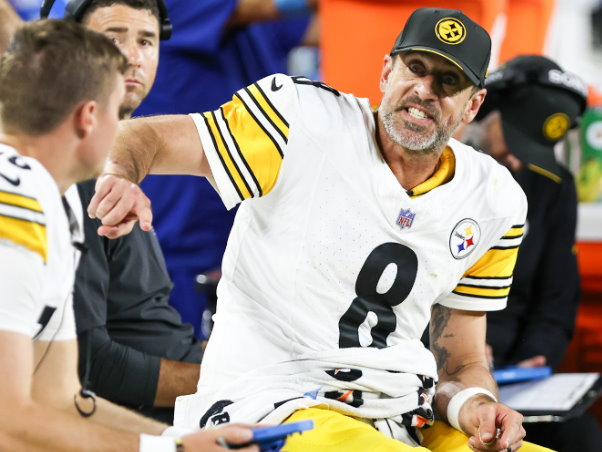
Questions afterward centered on plays arriving late and visible sideline exchanges between Rodgers and McCarthy.
McCarthy pushed back on the idea that communication was consistently poor, saying the marathon opening possession forced him to talk faster than usual before things settled.
Rodgers offered a slightly different explanation.
“It was loud,” he said. “It was definitely a good crowd tonight. Some of the calls, it was hard to hear for sure.”
McCarthy also addressed the animated communication caught during the game.
“Everybody’s competing on the field,” he said, before acknowledging, “Any negative communication on my part, I wish I wouldn’t use those words.”
That matters, but probably not for the reason television cameras make it matter.
Mason Rudolph joked over the summer in Latrobe that the pair argue like an old married couple when watching film. It’s not animosity, it’s more playful busting of one another’s stones.
Rodgers and McCarthy arguing isn’t automatically evidence of fracture. The more interesting question is whether Pittsburgh’s offensive machinery was operating cleanly enough when Cleveland was already demanding fast answers.
Protection calls. Play communication. Route separation. Quarterback clock. Actual play clock.
Against passive defense, small delays can disappear.
Against five-man pressure and sticky man coverage, they compound.
McCarthy spends considerable time preaching situational football, which made his postgame assessment particularly pointed.
“You get what you emphasize in this league,” he said. “We put a tremendous amount of time and energy into situational football.”
Then came the verdict.
“We came up short.”
Pittsburgh proved Thursday it could move the football against Cleveland. It did it for nearly 10 uninterrupted minutes to begin the night and again when the game was slipping away.
What the Steelers couldn’t do was keep the machine running between those two points.
And that might be more concerning than five sacks.
.
Photo Credit Frank Hyatt/College2Pro.com
