

by Bo Marchionte
@bomarchionte | College2Pro.com
Published July 27, 2026, 1:49 PM
Steelers Young QBs Have Leg Up on Competition
There are quarterback coaches, there are offensive gurus, and then there is the stuff Rich Gannon says Mike McCarthy does behind the closed door of a quarterback room.
Grab a cold one and settle in for this one, because Gannon isn’t evaluating McCarthy from across a television studio.
He lived it.
Appearing with Adam Schein on SiriusXM on Thursday, the former NFL MVP offered a fascinating window into McCarthy’s work with quarterbacks and more importantly for Pittsburgh, why the bottom half of the Steelers’ quarterback depth chart may matter almost as much as the top.
“You think about the OTAs, the minicamps, the offseason program, all the reps in training camps,” Gannon said. “Everything’s the focus is to get the starting quarterback and the offense ready to play.”
That’s the NFL.
The QB1 gets the reps. The QB1 gets the installation tailored to him. The QB1 gets organizational investment.
Gannon’s point is that McCarthy doesn’t stop teaching when he gets to QB2.
“I don’t believe there’s a better team or a better coach in football than Mike McCarthy when it comes to the development at that position as it relates to the second and the third and a practice squad quarterback,” Gannon said. “He’s awesome.”
That should make some ears perk up in Pittsburgh.
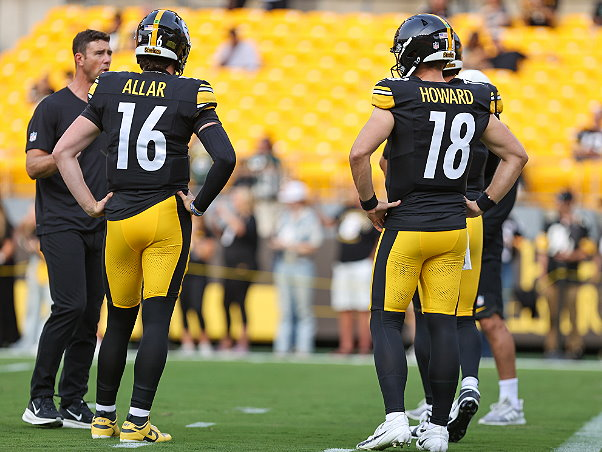
Because behind Aaron Rodgers sits one of the more interesting quarterback rooms in football: veteran Mason Rudolph, second-year developmental quarterback Will Howard and rookie third-round pick Drew Allar.
Rodgers is the present.
McCarthy’s real laboratory may be everybody standing behind him.
Gannon Was Once One of Those Guys
This is where Gannon’s opinion carries some weight.
Before there was an NFL MVP trophy, four consecutive Pro Bowls with the Raiders and a trip to Super Bowl XXXVII, there was Kansas City.
And McCarthy.
The two spent four seasons together from 1995-98, when McCarthy was the Chiefs’ quarterbacks coach. Gannon had already spent seven NFL seasons elsewhere before arriving in Kansas City. McCarthy wasn’t teaching a 22-year-old rookie how to take a snap.
He was rebuilding how an established NFL quarterback processed the position.
“That’s really where my game when I was with Mike McCarthy those four years in Kansas City. That’s after seven seasons in other places,” Gannon said. “That’s really where I started to better understand the importance of preparation, better understood the concepts, better understood the why. Why we call on this play in this certain situation.”
That last word matters.
Why.
Anybody can hand a quarterback a playbook and tell him where to throw the football. The advanced details is teaching him why the play exists, why it belongs against a particular coverage, why the protection changes against a certain pressure look and why the answer with 2nd-and-6 in the second quarter might change on 3rd-and-4 with the game hanging in the balance.
That’s quarterback development beyond arm talent.
Gannon has been saying versions of this for years. McCarthy’s old Kansas City quarterback meetings included extensive written tests covering offensive philosophy, protections, fronts and situational football.
And the results eventually became difficult to ignore.
After leaving Kansas City, Gannon went to Oakland and made four straight Pro Bowls, won NFL MVP in 2002 and took the Raiders to the Super Bowl.
McCarthy didn’t throw those passes.
But Gannon has never forgotten who helped him understand them.
Pittsburgh’s Quarterback Room Is Built for This
That’s what makes the Steelers’ current setup so intriguing.
Rodgers and McCarthy have enough shared football language and history that the veteran hardly needs an introduction to the curriculum.
Rudolph gives Pittsburgh an experienced NFL quarterback who understands how to survive Sundays.
Then come Howard and Allar.
That’s where Gannon’s comments become something more than another compliment for Pittsburgh’s new head coach.
Howard and Allar don’t simply get to watch Rodgers operate. They got Rodgers and a head coach whose reputation was partially built upon making sure the quarterbacks who weren’t starting continued developing anyway.
For Allar, the physical inventory has never been difficult to spot. He’s big, strong-armed and capable of accessing throws that can’t be coached into a quarterback.
Developmental work is everything between those throws. Speeding up the mental clock, marrying his feet to the concept, identifying pressure before the snap and understanding where the football needs to go before a defense finishes revealing itself.
Howard is in a different place, but the curriculum remains valuable.
Developmental quarterbacks live on details.
Their margin for surviving roster cuts and eventually earning meaningful NFL snaps isn’t enormous. Every protection check, coverage indicator, footwork correction and situational decision becomes part of the evaluation.
McCarthy apparently attacks that part of quarterback development relentlessly.
“Mike is phenomenal,” Gannon said. “He is phenomenal when it comes to attention to detail, when it comes to coaching that position, and I think it’s a big reason why he’s had prolonged success in the different places he’s been.”
That’s more interesting than calling McCarthy a quarterback whisperer.
Whispering makes it sound like magic.
This sounds more like school.
Preparation. Concepts. Protections. Situations. Footwork. Decisions. Understanding not merely what the answer is, but why it’s the answer.
Gannon walked into McCarthy’s quarterback room after seven NFL seasons and says his understanding of the position changed.
Three years after leaving Kansas City, he was the NFL’s Most Valuable Player.
Now McCarthy has Rodgers, Rudolph, Howard and Allar sitting in his classroom in Pittsburgh.
Rodgers may be the reason everyone is watching.
Howard and Allar might eventually become the reason Gannon’s words are worth remembering.
Photo Credit Frank Hyatt/College2Pro.com
