

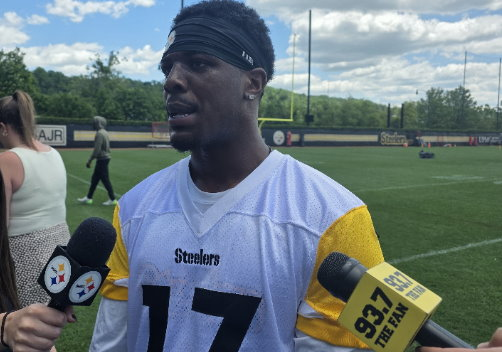
Bernard Has Chance Early For Production
by Bo Marchionte
@bomarchionte | College2Pro.com
Published May 31, 2026, 5:39 PM
Long before Germie Bernard arrived at Michigan State in 2022 as a four-star recruit he played running back early on in his football career.
That resonates deeply in the receiver we’ve come to know.
He was the pop warner star with those eye dazzling performances where the crowd of moms and dad sat in lawn chairs on the side of the football field.
“I probably went for, like, it was a championship game, I went for like 200 some rushing yards, and like three TDs,” Bernard said after OTA practice.
That’s where the football DNA begins to reveal exactly who Bernard is as a receiver for the Pittsburgh Steelers.
“I played running back really all the way up until my freshman year of high school, and then I kind of move all over,” Bernard said. “But they still kind of implemented me in the offense as a running back, you know, in certain, certain packages and whatnot. So, it’s always been in my repertoire.”
Bernard Brings Deebo Samuel Similarities
Tucked behind two solid veterans in D.K. Metcalf and Michael Pittman, Bernard doesn’t face the force-fed challenge of carrying the burden of the passing game. He’ll be able to percolate behind the veterans and gain confidence within the coaching staff.
“It’s the learning curve of being able to line up alignment, assignment, technique to know what you are doing when you break the huddle,” Steelers new receiver coach Adam Henry during interviews.
It’s that combination of factors which Henry believes in this limited time around Bernard will help the rookie validate his second-round selection status from the 2026 NFL Draft.
“He did a 30 visit here,” Henry said of Bernard. “I was really really satisfied. I mean I was impressed with him and the whole process of the day. I know he had some good coaches in college that I’m familiar with that coached him, that recruited him. So, I knew he had a good grasp for the game.”
Germie Bernard College Receiving Stats
- 2022 Michigan State: 7 Catches for 128 yards and two touchdowns
- 2023 Washington: 34 catches for 319 yards and two touchdowns
- 2024 Alabama: 50 catches for 794 yards and two touchdowns
- 2025 Alabama: 64 catches for 862 yards and seven touchdowns
Henry has spent nearly two decades coaching wide receivers at both the college and NFL levels. He has worked around elite talent, demanding quarterback play and high-pressure offenses where details determine everything. During his time coaching alongside Eli Manning, Henry learned quickly that quarterbacks operating at that level have little patience for mental mistakes or communication breakdowns.
“So, if I’m a receiver, I’m going to do what?” Henry asked the swarm of media inside the UMPC Rooney Sports Complex. “I’m going to do what, I’m going to do what the quarterback wants.
That’s going to be one of the biggest developments for Bernard to gain the trust of Aaron Rodgers. A rookie receiver must capture that confidence quickly or the four-time league MVP will disperse the football in another direction.
That’s the world Bernard is now entering.
The encouraging part for Pittsburgh is Henry believes the rookie is handling the process the right way. Bernard has approached meetings, walkthroughs and practice habits with maturity, understanding that trust from Rodgers won’t simply come because of draft status or athletic ability.
Germie Bernard Rushing College Stats
- 2022 Michigan State: 1 carry, 3 yards
2023 Washington: 13 carries, 43 yards, 2 touchdowns
2024 Alabama: 4 carries, 37 yards, 1 touchdown
2025 Alabama: 18 carries, 101 yards, 2 touchdowns
Each stop along the way brought more opportunities, more responsibility, and ultimately more production. From Michigan State to Washington and finally Alabama, Bernard consistently found ways to expand his role.
While Bernard’s primary job was catching passes, the rushing totals offer another glimpse into the versatility that made him attractive to NFL scouts. Offensive coordinators routinely looked for ways to get the football into his hands, whether that meant lining him up out wide, in the slot, or utilizing him as a ball carrier.
By the time his career concluded at Alabama, Bernard had developed into one of the Crimson Tide’s most dependable offensive weapons. Some observers would argue he was the more consistent option opposite highly regarded 2027 NFL Draft prospect Ryan Coleman-Williams.
Now the second-round selection finds himself in an ideal environment for continued growth.
Bernard enters a Steelers offense directed by Mike McCarthy, whose reputation for quarterback development and offensive structure spans decades. He’ll also spend his rookie season alongside Aaron Rodgers, a future Hall of Fame quarterback whose attention to detail has already become evident throughout organized team activities.
For Bernard, the opportunity still feels surreal.
“Yeah, man, so this is dream come true,” Bernard said. “It’s definitely a blessing just to be out here learning from everybody, being on the NFL team, you know, I’m fulfilling my dreams.”
The learning process extends well beyond Rodgers.
Pittsburgh’s receiver room features accomplished veterans D.K. Metcalf and Michael Pittman, but Bernard was quick to note that every player in the room has helped him during his transition to the professional game.
When asked which veteran has been most influential thus far, Bernard didn’t hesitate.
“All of them,” Bernard said.
The answer speaks volumes about both the culture of the room and Bernard’s willingness to learn.
“So. I’m just very excited to be out here, you know, with each and every one of the guys, man, and to, you know, work to, you know, until the season comes and work to get to the playoffs and Super Bowl.”
Germie Bernard vs. Deebo Samuel Sr.
Pre-Draft Measurements & Combine Testing
Category Germie Bernard Deebo Samuel Sr.
- Height: 6’1 1/4″ 5’11 1/4″
- Weight: 206 lbs. 214 lbs.
- Arm Length: 30 3/8″ 31 3/8″
- Hand Size: 97/8″ 10″
- 40-Yard Dash: 4.48 4.48
- 10-Yard Split: 1.52 1.48
- Vertical Jump: 32.5″ 39.0″
- Broad Jump: 10’5″ 10’2″
- 3-Cone Drill: 6.71 7.03
- 20-Yard Shuttle: 4.31 4.14
On the Steve Smith Podcast they dived into comparing Bernard and veteran All-Pro receiver Deebo Samuel. It’s something that Bernard feels in a compliment.
“Yeah, man, it’s a big comparison,” Bernard said. “I mean, De Bo is one of the top receiving the league, you can utilize them in every kind of way, and so, like, I think that kind of player is very valuable.”
Over the course of his seven years in the NFL, Samuel has rushed carried the football 219 times for 1.218 yards and 21 touchdowns. Remember Ty Montgomery’s success in Green Bay with Mike McCarthy. The Stanford wide receiver become one of the best weapons on the Packers offense under the direction of McCarthy.
“Yeah, I believe so,” Bernard said in reference to running the football. “You know, just know, kind of playing like a running back when you get the ball. I just want to do the best for my team, man, and put my team in the best position.”
The 40-yard dash gets the headlines. The 3-cone drill is where scouts start paying attention.
For a receiver, a 6.71-second 3-cone isn’t just good it was the best recorded time by any player at the 2026 NFL Combine.
Why does that matter?
Because the 3-cone drill measures something closer to actual receiver play than a straight-line sprint ever will. It tests how efficiently a player can sink his hips, redirect, accelerate out of breaks and maintain body control through sudden movement. In simple terms, it measures whether a receiver can get open.
NFL offenses are built on separation.
Defensive backs today are too athletic for receivers to simply run past everyone. Winning often comes down to creating two feet of space at the top of a route. That’s where elite change-of-direction ability shows itself.
Ironically, when comparing Bernard to Samuel coming out of South Carolina, Bernard actually posted the superior 3-cone time. Samuel ran a 7.03. Bernard checked in at 6.71. Both ran identical 4.48 forty-yard dashes, but Bernard showed more short-area efficiency during testing. That doesn’t mean he’s Deebo. It simply highlights a trait NFL teams’ value.
The number becomes even more impressive when paired with Bernard’s size. At 6-foot-1 and 206 pounds, he isn’t a smaller slot-only receiver relying on quickness. He carries legitimate NFL frame density while still posting elite agility numbers.
Combine Measurements & Performance
- Height/Weight: 6’1″ / 206 lbs.
- 40-yard dash: 4.48
- 3-cone drill: 4.31
- 20-yard shuttle: 4.31
- Vertical jump: 32.5 inches
- Broad jump: 10’5″
- Arm length: 30 3/8″
- Hand span: 9 7/8″
At first glance, Bernard looks like a wide receiver. Turn on the tape and there are moments where he resembles a running back disguised as one.
That’s what makes Bernard an intriguing projection for Pittsburgh. At 6-foot-1 and 206 pounds, he arrives with NFL size, verified speed (4.48) and enough functional strength to handle traffic. But his game isn’t built around dazzling defenders with endless shake. Bernard wins with tempo, physicality and an understanding of how to finish runs once the ball is in his hands.
The former Alabama receiver consistently showed a willingness to work the middle of the field, absorb contact and turn modest gains into chain-moving plays. He runs with balance and purpose, often falling forward and forcing defenders to complete tackles rather than simply making contact. That “running back mentality” isn’t just a catchy phrase. It shows up after the catch when Bernard lowers his pads, fights through arm tackles and squeezes extra yardage out of seemingly finished plays.
As a route runner, he is still refining the details. Bernard isn’t the twitchiest separator in the class and likely won’t make a living solely on suddenness. Instead, he creates opportunities through body positioning, timing and strong hands at the catch point. His 9 7/8-inch hands are evident when plucking the football away from his frame and securing contested catches.
The athletic profile is solid across the board. A 4.48 forty, 10-foot-5 broad jump and 32.5-inch vertical point to a player with enough explosiveness to threaten defenses without relying entirely on straight-line speed.
For Pittsburgh, Bernard’s value may ultimately come from versatility. He can align outside, work from the slot, contribute on special teams and provide offensive coordinators with a player who doesn’t fit neatly into one box. He may never be the flashiest receiver in the room, but his combination of toughness, reliability and competitive temperament gives him a realistic path to earning snaps early in his career.
Steelers Second Round Receiver 2017-26
- 2026: Germie Bernard, Second Round 47th overall
- 2022: George Pickens, Second Round 52nd overall
- 2020: Chase Claypool, Second Round, 49th overall
- 2018: James Washington, Second Round, 60th overall
- 2017: JuJu Smith-Schuster, Second Round, 62nd overall
The Pittsburgh Steelers have never been afraid to invest premium draft capital at wide receiver. Since 2017, the organization has selected nine receivers in the NFL Draft, and more than half of them, five to be exact, arrived as second-round selections.
The latest name added to that list is Bernard.
What makes Bernard’s arrival interesting isn’t simply where he was drafted. It’s the company he joins.
The Steelers have built a league-wide reputation for uncovering wide receiver talent. Long before draft analysts turned the position into a year-round obsession, Pittsburgh was finding stars in places others overlooked. Antonio Brown arrived as a sixth-round pick in 2010 and became one of the most productive receivers of his generation. Mike Wallace was a third-round selection. Emmanuel Sanders came in the third round as well. The list goes on.
Yet when it comes to the second round, the results have been far less predictable.
Some selections developed into productive NFL contributors. Others flashed potential before injuries, inconsistency or circumstance altered their trajectory. That’s what makes Bernard such a fascinating case study. History suggests being a second-round receiver in Pittsburgh comes with both opportunity and expectation.
He isn’t arriving as a finished product, but he does possess the type of versatility that modern offenses covet.
Perhaps that’s why Bernard feels like a classic Steelers gamble. Not because he’s a risk, but because he represents a familiar bet. Pittsburgh believes it can identify traits that translate beyond college production and develop them into NFL success.
The previous nine wide receivers drafted since 2017 have produced a mixed bag of results. Some became household names. Some never fully found their footing.
Now Bernard gets his turn.
And if Steelers history has taught us anything, it’s that the next chapter is rarely written on draft weekend.
Photo Credit Frank Hyatt/College2Pro.com
