

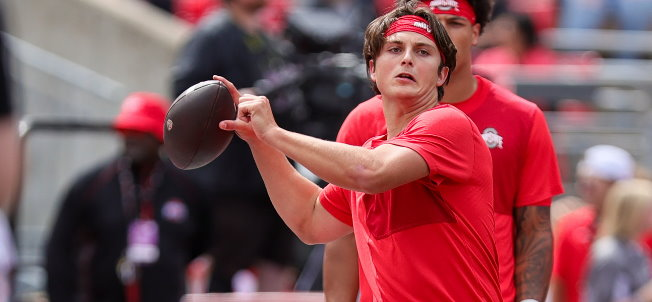
Julian Sayin Shows Accuracy at Ohio State
by Bo Marchionte
@bomarchionte | College2Pro.com
Published May 12, 2026, 11:49 AM
Quarterback evaluation has evolved dramatically over the last two decades. NFL offenses now embrace mobility, off-platform creativity and designed quarterback runs in ways that were once considered secondary traits. The position no longer belongs exclusively to statues in the pocket.
Yet amid all the change, one principle remains largely unchanged inside scouting departments: quarterbacks are expected to complete routine throws with consistency.
For decades, passers who hovered near or below 60 percent completion in college have faced heightened scrutiny. Falling below that threshold does not automatically disqualify a prospect, but it often forces evaluators to look deeper into whether the issue stems from mechanics, footwork, anticipation, decision-making or simple ball placement.
The 60% Warning Sign: Why Accuracy Still Shapes QB Evaluations
At its core, the quarterback position is still about delivering the football accurately and on time. Arm strength can stretch the field. Athleticism can create second-chance opportunities. But neither trait matters if the quarterback struggles to execute the ordinary throws that keep an offense on schedule.
The ability to operate from the pocket remains the foundation of the position. Even in an era dominated by athletic dual-threat quarterbacks, winning consistently in the NFL still requires precision from within structure. Third-and-six in December, with pressure collapsing and weather deteriorating, is where accuracy separates traits from true quarterback play.
Completion percentage can be influenced by offensive design. Vertical passing attacks naturally produce lower percentages than quick-game systems built around screens and high-percentage throws. Context always matters. But completion percentage remains one of the first numbers scouts examine because it offers an immediate snapshot of efficiency and consistency.
The Historical Context
Notable Historical Examples
Quarterbacks with sub-60% college completion rates have often become boom-or-bust bets.
- Josh Allen – 56.2% at Wyoming, elite traits overcame the concern.
- Anthony Richardson – 53.8% at Florida, drafted on upside.
- Jordan Love – 61.2% career, but had a 61.9% final season with erratic tape.
- Will Levis – 65.7%, but accuracy inconsistency was a major discussion point.
Allen remains the exception to every evaluator references. For every quarterback who overcomes inconsistent college accuracy, many others never fully solve the issue.
2027 NFL Draft Quarterbacks Under the Microscope
The 2027 quarterback class is rich in talent, but several high-profile prospects enter the 2026 college season with accuracy questions that will influence how they are viewed.
Arch Manning completed 61.4 percent of his passes in 2025, which ranked 87th in the country. That number is not alarming, but it falls below the hyper-efficient standards often associated with quarterbacks projected near the top of the draft. Scouts will be looking for greater consistency on anticipation throws and better rhythm from the pocket.
LaNorris Sellers is one of the most gifted athletes in the class. His size, arm strength and running ability are undeniable, but evaluators will focus closely on footwork and accuracy on intermediate concepts.
John Mateer is a dynamic creator with impressive off-platform ability. The next step is proving he can maintain efficiency and precision against top competition.
Quarterbacks Already Showing Strong Efficiency
Several prospects enter the season with stronger completion profiles.
Julian Sayin completed 77.0 percent of his passes in 2025, demonstrating outstanding timing and accuracy. Dante Moore continues to build a reputation as an efficient and explosive passer, while Fernando Mendoza has shown the traits of a poised, highly accurate distributor.
The Real Evaluation Filter
Every quarterback can make the spectacular throw. Every quarterback prospect has a highlight reel filled with deep balls, off-platform lasers and escapes from pressure.
What separates franchise passers is their ability to complete the ordinary throws over and over again.
Completion percentage is not a final verdict, nor should it be viewed in isolation. But it remains one of the quickest and most revealing indicators of whether a quarterback has unresolved issues that could follow him to the next level.
When NFL teams study the 2027 quarterback class, they will be asking a simple question.
Can this player make the routine look routine?
This is Arch Manning’s nemesis.
Andy Reid, head coach of the Kansas City Chiefs, once offered a simple but brutally honest evaluation of quarterback play.
“If they can’t throw the ball from me to you, accuracy becomes a big thing. And if they’re not smart.”
I still remember Reid pointing directly at me when he said “from me to you” during a media scrum. It was a cool moment, but the message carried far more weight than the gesture. Reid is one of the finest quarterback developers in NFL history. From Donovan McNabb to Patrick Mahomes, he has consistently identified traits that translate to the professional game.
When Kansas City selected Mahomes with the 10th overall pick in the 2017 NFL Draft, his final season at Texas Tech Red Raiders football included a 65.7 percent completion rate and a 157.0 passer rating. Those numbers were impressive, but they also serve as a reminder that statistics require context. Metrics can spotlight elite prospects, but they can also inflate quarterbacks who are not equipped to thrive on Sundays.
Accuracy remains one of the clearest indicators of future success.
Since 2017, eight quarterbacks have gone No. 1 overall in the NFL Draft. Looking at their final college seasons offers a useful benchmark, especially when evaluating the leading contenders for the top selection in the 2027 NFL Draft.
Passing Completion Percentage (Highest to Lowest)
Bold indicates current college quarterbacks
- Julian Sayin – 77.0%
- Joe Burrow – 76.3%
- Fernando Mendoza – 72.0%
- Dante Moore – 71.8%
- Baker Mayfield – 70.5%
- Trevor Lawrence – 69.2%
- Kyler Murray – 69.0%
- Caleb Williams – 68.6%
- Cam Ward – 67.2%
- Bryce Young – 64.5%
- Arch Manning – 61.4%
Among the current college quarterbacks on this list, Manning sits at the bottom. Remove Young’s relatively modest 64.5 percent mark, and Manning stands noticeably closer to the danger zone than to the established standard.
That does not mean he cannot develop into the top pick. Completion percentage alone does not define a quarterback. Offensive structure, receiver play, protection, and downfield aggressiveness all influence the final number.
Still, history shows that quarterbacks selected first overall usually pair elite physical tools with strong efficiency. Once a passer dips toward the 60 percent threshold, evaluators begin asking tougher questions about anticipation, ball placement, and decision-making.
Manning still possesses every trait scouts covet: prototypical size, NFL bloodlines, mobility, and high-level arm talent. But if he intends to secure the No. 1 overall spot in the 2027 NFL Draft, his completion percentage must climb.
As Andy Reid made clear, the evaluation starts with two non-negotiables.
Can he throw accurately from me to you?
And is he smart enough to handle everything that comes with playing quarterback in the National Football League?
Kevin Colbert, former Pittsburgh Steelers GM
“Inaccuracy. I think if you study quarterbacks over history, accuracy at the collegiate level is usually a great indicator of accuracy at the professional level albeit at in a different game. A lot of the college game is leaking into our game so there’s more similarities than there have been in recent years. But I think that’s the one trait of a quarterback again they’re all going to be different sizes, they’re all going to have different arm talent, they’re all going to have different athletic abilities. But if you ask me one thing that I think can identify a potentially tough quarterback it would be accuracy.”
Quarterback passer rating is one of the quickest ways to evaluate how efficiently a signal-caller operates within the structure of an offense. The NCAA formula combines completions, passing yards, touchdowns and interceptions into a single number designed to reflect overall effectiveness as a passer. In simple terms, it rewards quarterbacks who consistently complete throws, generate explosive plays and finish drives with touchdowns while protecting the football.
The metric is not intended to measure arm strength, athletic ability or leadership traits. Instead, it serves as a statistical snapshot of how often a quarterback turns dropbacks into positive outcomes. A high rating typically indicates strong accuracy, sound decision-making and the ability to create chunk plays without putting the ball in harm’s way.
Ohio State Quarterbacks Thrive in System
Context still matters. Quarterbacks operating in quarterback-friendly systems with superior surrounding talent can post inflated numbers, while those in vertical offenses that push the ball downfield may accept a lower completion percentage in exchange for more difficult throws. Even so, passer rating remains one of the first efficiency markers scouts and evaluators review because it blends production, scoring and turnover avoidance into one easily digestible figure.
In general, ratings above 170 reflect outstanding efficiency, while anything approaching or exceeding 190 often places a quarterback among the most productive passers in college football. Like every statistic, it is most useful when paired with film study, where mechanics, pocket presence, timing and anticipation reveal whether the production will translate to the next level.
No. 1 NFL Draft QBs 2016-2026 | Trio of Sayin, Moore and Manning
- Joe Burrow 202.0
- Kyler Murray 199.2
- Baker Mayfield 198.9
- Fernado Mendoza 182.9
- Julian Sayin 177.5
- Cam Ward 172.2
- Caleb Williams 170. 1
- Trevor Lawrence 169.2
- Dante Moore 163.7
- Bryce Young 163.2
- Arch Manning 144.9
Photo Credit Frank Hyatt/College2Pro.com
