

Greatness Hidden Behind Behavior
by Bo Marchionte
@bomarchionte | College2Pro.com
Published May 8, 2026, 11:49 AM
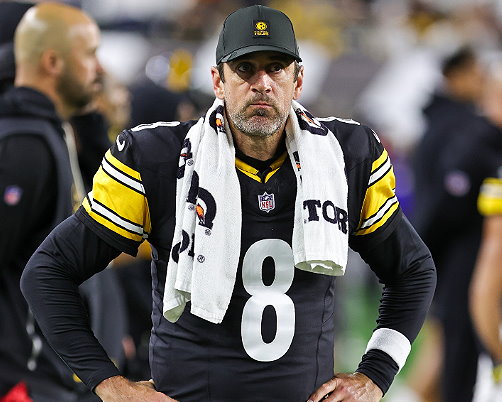
Aaron Rodgers was always going to make this feel bigger than football.
That’s part of the appeal. Part of the exhaustion too.
Oddly enough, one of the closest comparisons may not come from football at all. That’s what stars do, especially stars who understand branding, mystique and attention as well as Rodgers.
If you watched Ted Lasso, the similarities between Rodgers and superstar Zava are hard to ignore. The self-awareness. The eccentric confidence. The feeling that every room subtly shifts once he walks into it. Zava wasn’t just talented; he carried himself as if the entire environment naturally orbited around him. Teammates admired him, rolled their eyes at him, depended on him and occasionally seemed exhausted by him all at once.
The Zava comparison is ultimately a compliment because anyone around the Steelers facility daily understands Rodgers’ influence and playful nature. He is serious about football, but he also enjoys teaching the game in a relaxed and approachable way.
During his first training camp in Pittsburgh, Rodgers quietly worked to fit in despite the larger-than-life presence that naturally follows him everywhere.
Rodgers’ is Team Oriented in big ways
He wasn’t loud or operating with some rah-rah leadership style at the front of every drill. Instead, Rodgers was often the guy sliding into the fifth row during stretching lines, leaning over to a younger teammate and starting a conversation like they had known each other for years.
“That is intentional,” Rodgers said. “You know, I’ve kind of found myself in like the fifth line over to the right, anywhere from like third to the seventh line, but like to grab somebody new and, you know, just have a quick chat with them.”
Rodgers also made a point to sit with different teammates during meals, not because he had to, but because he understood how intimidating it could feel for a fifth-round rookie to approach one of the greatest quarterbacks in NFL history.
So, Rodgers handled it himself.
“A lot of guys are a little shy to maybe come up to us,” he said with a smile. “You got to break the ice often with them. Some of us just like going out sitting next to them for lunch and kind of go, What the hell are you doing here? I’m having lunch.’”
When Rodgers returns to Pittsburgh and eventually, he will the reaction will likely split the city down the middle. One side will see a future Hall of Fame quarterback still capable of giving the Steelers relevance at the game’s most important position. The other will see another chapter in the long-running theater production that has followed Rodgers throughout much of the second half of his career.
Both sides will probably be right.
Steelers Know the Routine from 2025
For months, the Steelers have operated in a strange state of public limbo. The organization attempted to move forward under new head coach Mike McCarthy while Rodgers’ decision hovered over everything from offseason workouts to quarterback development. Drew Allar became the future hope. Will Howard became the fan-favorite mystery box. Yet neither conversation ever fully took over because Rodgers, even without officially returning, still dominated the attention around the franchise.
Over the years, Rodgers has built a public image that feels less like a traditional NFL quarterback and more like a carefully layered character study. Darkness retreats. Cryptic social media posts. Weekly philosophical detours. Public feuds that simmer without ever fully boiling over. At times, following Rodgers feels less like covering an athlete and more like trying to interpret performance art from someone who also happens to throw effortless 40-yard lasers off-platform.
That dynamic has followed Rodgers everywhere.
In Green Bay, the brilliance outweighed the noise because winning usually does. Four MVP awards, a Super Bowl title and one of the purest throwing motions the game has ever seen bought Rodgers a different level of tolerance. With the Jets, the balance shifted. The Achilles injury in 2023 stalled the story before it truly began, and by the time he returned, frustration surrounding the organization became impossible to ignore.
Still, Rodgers remains a master of the position.
He may present himself in unconventional ways publicly, but behind the scenes he has consistently been viewed as engaging, funny and deeply invested in teammates. Rodgers is calculated in his responses, but approachable in daily interaction and highly team oriented.
Center Zach Frazier discussing how Rodgers helped explain run-blocking concepts is only a small glimpse into how involved he becomes in helping teammates understand the offense as a complete operation.
The Zava effect.
The Steelers spent nearly two decades under Mike Tomlin operating with quarterback stability. Ben Roethlisberger frustrated people at times, but the structure itself rarely felt unstable. Rodgers changes that dynamic immediately. He arrives with opinions, preferences and a gravitational pull that naturally shifts focus toward him. Even when he says very little, the conversation somehow becomes about him anyway.
At the same time, Pittsburgh may actually be one of the few organizations built to handle it.
Art Rooney II has historically preferred patience over reaction, and Mike McCarthy understands Rodgers better than almost anyone after their years together in Green Bay. That familiarity matters because coaching Rodgers requires balance. Too much control can create friction. Too little can create drift.
Don’t let the delay in signing hide the fact that he is one of the best to ever play the position and we should be thankful he will be returning for his 22nd season in the National Football League.
Photo Credit Frank Hyatt/College2Pro.com
