

Different but the same
by Bo Marchionte
@bomarchionte | College2Pro.com
Published February 3, 2026, 9:41 AM
For a large portion of the Steelers fan base, the move away from Mike Tomlin came with dreams of a scorched earth reset. New language. New philosophy. An unmistakable break from the past that screamed this is different now.
Instead, Pittsburgh landed on Mike McCarthy a choice that, at first glance, feels familiar. Safe. Almost defiantly conservative.
And yet, beneath that familiarity sits one of the most significant philosophical pivots this franchise has made in decades one that stands out even when stacked against the legacies of Chuck Noll, Bill Cowher, and Tomlin himself.
For nearly six decades, the Steelers’ identity has flowed from the defensive side of the ball. Noll’s dynasty was built on defense. Defense wasn’t just a unit it was the spine of the organization.
That blueprint carried through Cowher. It survived into the Tomlin era. Three head coaches. One way of doing things.
Until now.
When you examine the current roster alongside the long-standing ideology of owner Art Rooney II, the picture sharpens. Rooney is as strait-laced as they come a custodian of tradition, not a disruptor. And yet, this is about as far as he could possibly bend without breaking the Steelers’ DNA.
Unlike his grandfather Art “The Chief” Rooney and his father Dan Rooney both of whom leaned into defensive innovators. Rooney II bypassed the trendy young defensive coordinator route entirely.
That’s a pretty bold move.
The popularity of defensive coordinator Chris Shula was the buzz of popularity in mid-January. He remains on the Rams coaching staff. Immediately after Tomlin’s departure this was the name people wanted. Ironically none of the coach less NFL’s teams felt his hiring was worthy at this juncture of his career.
So, Rooney zigged when the fans wanted him to zag.
Rooney didn’t torch the house.
This wasn’t reckless. It was restraint with intent.
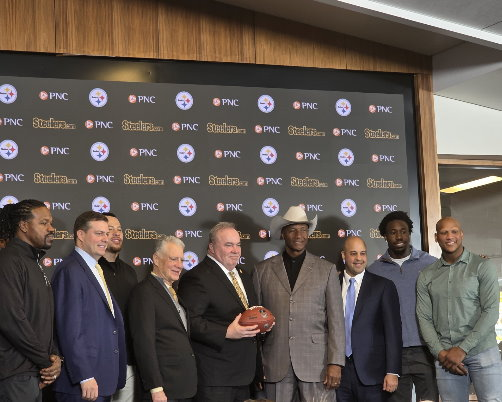
McCarthy’s introductory press conference told you everything you needed to know if you were paying attention. Joey Porter Sr. and Joey Porter Jr. in the room. Mel Blount, a living pillar of Steelers’ history ever-present from Latrobe to Acrisure Stadium. Charlie Batch, Pittsburgh born and bred, former quarterback, now a voice of the franchise.
If you know this team and more importantly, this city that matters.
McCarthy choking up wasn’t theater. It wasn’t branding. It was personal. For a Pittsburgh native, this wasn’t just another stop on a coaching résumé. It was a homecoming. And in a town quick to identify phonies, authenticity still carries weight or at least it should. Remember when Brian Kelly arrived at LSU and botched his introduction by trying to sound and act like he was from Louisiana.
How’d that turn out?
That wasn’t McCarthy’s presser. That was real emotion.
What McCarthy represents is disruption by reallocation.
This might look dual on the surface, but beneath all the bullshit and bitching, the Steelers are preparing to look fundamentally different on Sundays. The most obvious shift? The offense will no longer be a side project.
Pat Freiermuth immediately comes to mind a player who was effectively left to rot under Arthur Smith’s prehistoric playcalling. That changes. He’s now a factor and real contributor to the offense with McCarthy in house.
General Manager Omar Khan will almost certainly add another wide receiver to pair with DK Metcalf. And yes, Aaron Rodgers looms as the obvious quarterback bridge for McCarthy’s first season but Khan doesn’t operate on obvious alone. Remember Russell Wilson’s introduction? Hours later, Kenny Pickett was shipped to Philadelphia.
Khan plays poker, not checkers.
By taking direct control of the offense, McCarthy introduces something Pittsburgh hasn’t lived under in decades: a head-coach-driven model. This isn’t cosmetic. It’s a redistribution of authority and that’s the real shift.
You can hate the hire. You can despise it. But it’s hard to argue that the organization is standing still.
That philosophical change is reflected immediately in McCarthy’s staffing decisions.
One of his first and most telling hires was Patrick Graham as defensive coordinator. Graham a McCarthy alumnus from Green Bay with stops in Las Vegas, Miami, and New York signals alignment, not autonomy (big word for me). He’s here to execute within a vision, not redefine it.
That alone marks a departure in Pittsburgh, where defensive coordinators have traditionally carried enormous gravitational pull.
Coaching Staff Hires
Patrick Graham – Defensive Coordinator
Jason Simmons – Defensive Pass Game Coordinator/DBs
Frank Cignetti Jr. – Offensive Staff
James Campen – Offensive Line Coach
Jahri Evans – Assistant Offensive Line Coach
Ramon Chinyoung Sr. – Running Backs Coach
Adam Henry – Wide Receivers Coach
Scott McCurley – Inside Linebackers Coach
Danny Crossman – Special Teams (expected)
Strength & Conditioning / Support
Steve Scarnecchia – Chief of Staff
Mark Lovat – Strength & Conditioning Coordinator
Grant Thorne – Assistant
Abe Munayer – Assistant
Retained from Tomlin’s Staff
Tom Arth – Quarterbacks Coach
Justus Galac – Strength & Conditioning
Sit with that list for a moment.
This doesn’t scream “same old Steelers.”
It’s a entire change of the top down, while retaining the traditions of the Steelers.
Campen reinforces trench fundamentals. Adam Henry modernizes the receiver room. Jahri Evans brings a developmental edge from someone who’s actually lived elite offensive line play. Scarnecchia’s addition alone signals an organizational layer the Steelers have historically resisted.
At the same time, selective continuity remains. Tom Arth stays. Meanwhile, the departures of Arthur Smith, Teryl Austin, and Karl Dunbar confirm this is not a coat of paint.
It’s a remolding.
Rooney did make a big change.
It’s just camouflaged under the traditions of the Black-n-Gold.
In the end the matters.
